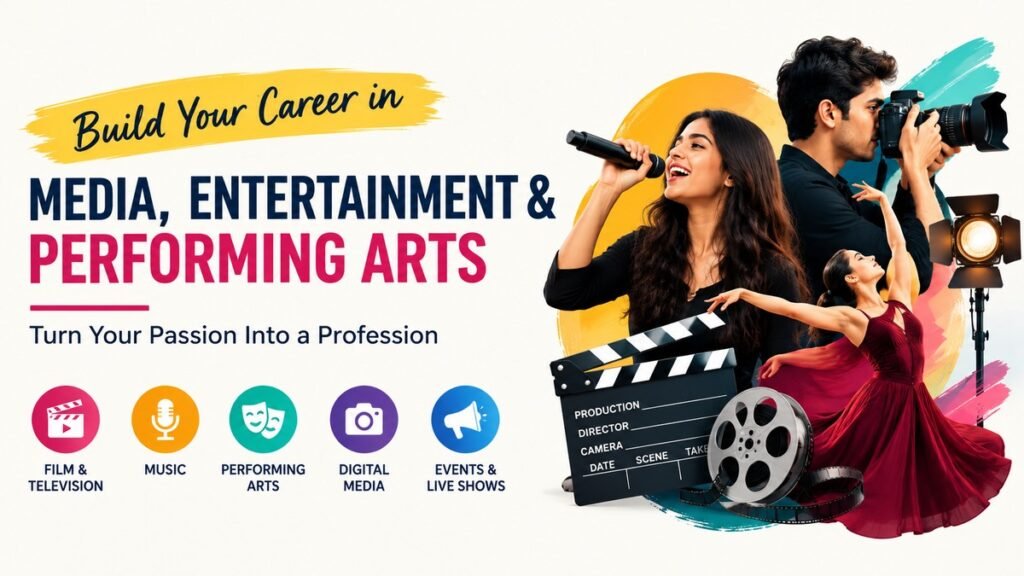
The media and entertainment world is a coalescing of creativity, communication, technology and storytelling. One can have a career in this industry in several aspects like making movies, radio shows, acting on stage, and taking unforgettable photos etc.
One of the best parts of this type of work is that you can not keep a single career for life. It’s okay to change careers after some time and discover what you’re proficient at.The most useful thing about practical training is that creative jobs will be very difficult to do if you lack practice and experience in it.
1. Why Choose a Career in Media and Entertainment?
In the media and entertainment industry, creativity, communication skills, technological know-how and storytelling skills all combine. There are many different ways to go about achieving your dreams, whether you are making videos, creating radio shows, arranging shows, organizing photography or anything else.
The best part of picking this business towards your career is the opportunity to work in a variety of positions. It is absolutely okay to experiment with specializations, discover what you’re good at, and select the one you like the most.
If he has a creative field then hands-on is quite important especially in his field as theory is not sufficient.This can be helpful in gaining confidence and skills through real life interactions with devices, some projects, rehearsal and feedback.
2. Explore Different Career Opportunities
Radio Jockeying and Broadcasting
A radio jockey is supposed to be a good speaker, a story teller, a music lover and a person. Radio Jockeys present and present radio programmes, welcome the audience, set the tone of the programme with music, communicate with the audience and convey information.
Every student who wants to be a radio presenter will get Voice Modulation Training, Pronunciation, Script Reading, Microphone Management & Program Introduction.
Acting and Performing Arts
Those who enjoy portraying themselves in roles and conveying emotion and narrative through acting should consider this field of study. There are jobs in theatre, film, TV, advertising and web series and on digital media.
Acting classes can help actors learn to use script, understand and apply it, express emotion, use body language and improvise. Another facet of acting is rehearsals and auditions.
Photography and Cinematography
Photography is a blend of creativity and technique that captures life’s moments and tells stories with images. Cinematography is a step higher that captures the visuals that are able to move with a number of techniques and lighting and composition and camera movement.
Learners will be able to investigate: Photography, Events Photography, Portraits, Product Photography, Movie Making, Music videos and Video Production. Understanding more about the work of the camera, lighting, framing and editing may be helpful.
DJing and Music Production
In the music world, learners who are passionate about music can get into DJing. This will allow them to mix various tracks while creating captivating experiences for people at parties and other events.
Another aspect of music that the learner could consider learning about is music production. Here the learner will learn all the steps of recording, arranging, and producing audio professionally.
Singing and Vocal Performance
Singing can turn into a creative activity and career opportunity for those who like singing. One can try out singing live, recording in the studio, releasing music digitally, being a backing vocalist, or creating online content.
It is necessary to learn voice training, control of the pitch, rhythm, breathing exercises, and practice regularly to develop one’s singing abilities. Having a repertoire of one’s recordings and performances is also important.
Digital Media and Content Creation
Digital world offers opportunities to make video, podcast, edit video, make presentation, tell stories.
Good creation is storytelling, video editing, and engaging the audience and creating content.
3. What Skills Do You Need to Succeed?
Some skills are suited to a variety of specialisations within media and entertainment and others are relevant to most.
- Effectively communicate information in writing and orally; get along and work well with others and colleagues.
- Creativity: Generate ideas, experiment with different ways and tell interesting stories.
- Knowledge of operation: Basic knowledge of how to use cameras, microphones, lights, audio software or any other equipment that may apply to a certain industry.
- Communication: talk, act, present and share their work.
- Team working: Share and collaborate with the directors, artists, technicians, producers and other people involved in the creative industry.
- Be flexible: Take tips and tricks, learn to use new tools and innovation in the creative form.
- Consistency: Practice regularly, continue to develop skills.
It doesn’t need to be done all at once! Begin by practicing the skills appropriate to the selected specialisation and build these skills over time.
4. How to Start Your Career in Media, Entertainment and Performing Arts
When you have a learning plan, it is easier to build a career in a creative industry.
Step 1: Determine your interest. Decide which of the following areas are you interested in (acting, radio, photography, cinematography, singing, DJ/digital media).
Step 2: Choose suitable training. Enclose courses and workshops that are congruent to the aims. Please browse the syllabus, practical sessions, experience of the trainer, equipment, length of course and course content before signing up.
Step 3: Practise regularly. Create small projects, record audio, create small videos, act scenes, take photos of various things or practise music mixing.
Step 4: Make a portfolio. Work together in teams to perform the best you can.
Step 5: Gain experience. Look for internships and auditions, workshops, freelance projects, student projects, collaboration.
Step 6: Keep learning. Stay updated about industry trends, undertake technical progress and gain knowledge from seasoned experts.
5. Can You Build a Career After Class 12?
Certainly, there are a number of possibilities for students to pursue in the field of media and performing arts following Class 12th.
Each programme has specific requirements, depending on the programme and the institute. Some courses may have a particular educational criterion in mind for entry to the course, but others may focus on auditions, portfolios, practical tests and/or interest.
It is of utmost importance that student recalls the conditions of admission of the course in which student wants to take admission.In addition, they must consider several important aspects, such as cost, specialization, course length and career options.
6. Why Practical Training Matters
The creative skills are acquired through experience. Learning about the technique of the camera, voice modulation, or acting methods might give valuable knowledge, but it is also crucial to practice the techniques.
Practical training enables pupils to be able to make mistakes, to experiment and gather feedback and be able to improve their performance. These are all good opportunities to practise through studio exercises, mock auditions, recording sessions, photography projects and collaborative projects.
The following items should be taken into account when assessing training institutes: Experienced teaching staff, training facilities, well planned practical training sessions, individual training and portfolio projects. Ask to find out about placements and about the industry if possible and get details on what each programme offers.
Remember, after completing a course there is no job waiting for you. Besides, your skills, portfolio, professionalism, networking and perseverance are important as well.
Conclusion
Anyone wishing to be creative and develop skills may want to pursue a career in media/entertainment or performing arts. If you have an interest in radio jockeying, acting, photography, cinematography, DJing, singing or any other digital content creation, the first step is to determine your talents and the best way to learn.
The first thing to do is to take some small steps and take them regularly and regularly as a way of learning from others who have been doing it and as a way of developing a portfolio. With enough practice, planning, and patience, one can turn their creative abilities into a successful career.