
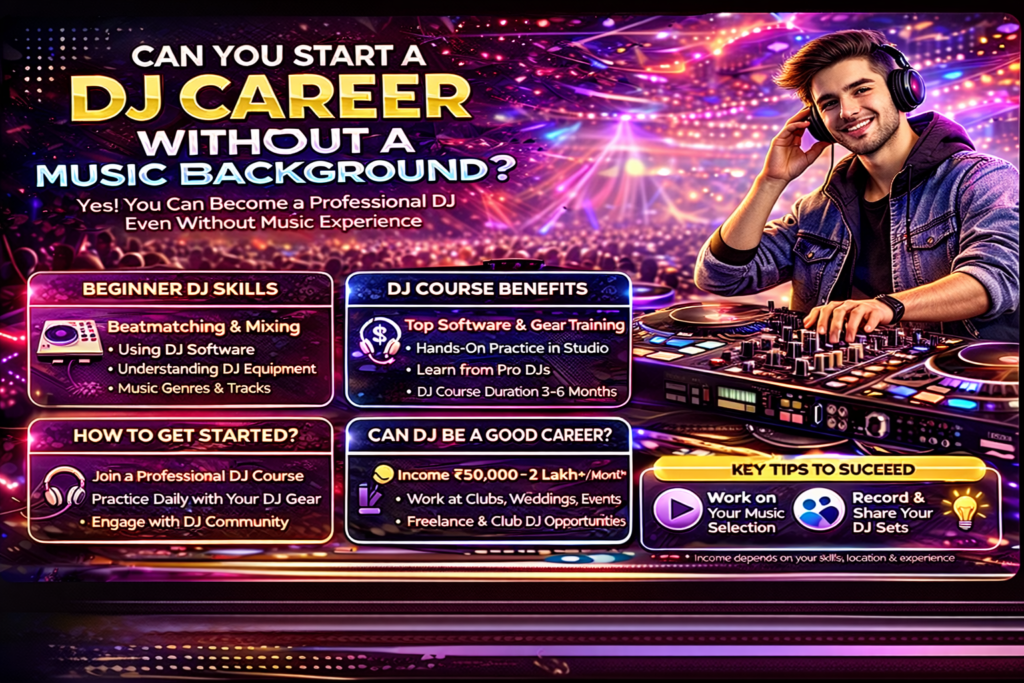
The thought of taking up DJing proves both an exciting and horrific feat, particularly for people without any With a formal background with music theories, many DJ-starting beginners hold the belief that it is impossible to gain entry into the DJ industry without learning how to play musical instruments or learning music. However, that is not the case in real life, one can professionally enter into the crowd reading skills DJ industry without having a music background, which many successful DJ’s have done today.
With the rise of digital tools, best DJ gear software, and online learning platforms, the barrier to entry has substantially dropped, the only thing that is necessary is the love for music, commitment to practice, and the hunger to learn, this comprehensive guide will tell you how to learn to DJ from scratch and the skills necessary to become a successful DJ.
Why A Music Background Is Not Necessary For Djing?
Unlike traditional musicians, timing skills for DJs are not always required to produce original music or play musical instruments. Instead, they emphasize on tracks mixing, energy control, and seamless musical journey creation. Modern technology has made DJing easier for everybody. Serato, Rekordbox, Virtual crowd reading skills DJsoftware has features such as automatic beat syncing, looping, key matching. The technical innovations enable beginner DJ skills learners to enhance their educational progress because they do not need prior knowledge to create their custom mixes accurately. The online world provides multiple tutorials along with courses and community platforms which help users to learn through detailed step-by-step instructions. DJing can be learned by anyone who wants to study at home without needing formal education or previous musical experience.
Essential Skills You Need to Become a Successful DJ
The DJ industry requires you to acquire certain essential skills which you must learn without needing formal education.
Beatmatching and Mixing
The fundamental beginner DJ skills of beatmatching basics enables DJs to select the correct beats per minute (BPM) for two tracks which will create an ideal audio combination. The process of seamless DJ mixing techniques allows DJs to transition between tracks without interruption which keeps their audience engagement DJ engaged on the dance floor.DJs today have access to various automatic syncing tools, but they can maintain better operational control through manual beatmatching basics techniques. The latter is critical for a professional disc jockey because a DJ can encounter many failures with equipment.
Music Selection and Playlist Curation
A successful beginner DJ skills song selection tips is not just a technician but a storyteller; The ability to pick the right track at the right time makes your performance. You need to; Different genres like EDM, hip-hop, house and techno Build playlists according to mood and audience Know about trending songs Good music selection can make an average set into an experience that will be remembered.
Understanding DJ Equipment
To begin your DJ journey, you need to get to know the basics of equipment; DJ controller; Mixer DJ song selection tips Headphones Speakers; DJ software; However, you don’t have to buy expensive equipment right from the start. For beginners, entry-level controllers are sufficient. Focus on acquainting yourself with the construction principles of each component and their interactional logic.
Sense of Timing and Rhythm
Even without formal educational trainings in the music industry, you must develop natural sense of rhythms. This helps in: Track changes at the right time Keep a constant flow Bring accuracy to your mixing; Over a period with detailed listening to songs and practising one’s self frequently will naturally enhance one’s sense of timing.
Reading the Crowd
Ability to read the audience engagement DJ is one of the most important skills for any DJ. Failure to read the crowd will also result in failure in a DJ’s career even if he possesses all the technical skills.
You need to observe; How people react to certain songs Vibe in the dance floor When to vary tempo or genre Assessing and adapting your set according to crowd response is what makes good timing skills for DJs great.
Creativity and Personal Style
Creativity is what defines you as a DJ. It is not just a case of playing tracks but how you present them.
You may; Transitions & Effects Work with Loops and Samples Make mashups Over time, one will learn to have a signature sound, which goes a long way in creating an identity in the DJ song selection tips industry. Basic Music Theory (Optional but Helpful)
Knowledge of basic music concepts is not a prerequisite but can never harm and more often helps to boost one’s DJ performance tips and mixing-quality, therefore, the knowledge about BPM (beats per minute), key matching, song structure can be of use to the individual. However, don’t let the lack of music theory stop you from getting started. All these concepts you can learn in your own time.
Networking and Personal Branding
In the digital world of today, talent is not enough—the need is also for visibility. To Grow DJ Career; Creating a presence on social media Upload Sharing soundcloud Work together with other DJs Choose a DJ name and logo that is unique to you.Strong branding enables businesses to develop their unique identity which brings new business opportunities.
Consistency and Practice
DJing requires practitioners to establish regular practice schedules because this consistency helps them become experts. The most successful DJs begin as unknowns who achieve success through dedicated training.The recommended schedule for practice requires you to practice daily or at least three times every week. Use your recorded mixes to evaluate your performance, identify errors, and work on eliminating them to improve future results. You will achieve speedier results because your dedication to work will bring better outcomes.
Handling Technical Issues
Live DJing is fraught with unexpected issues that include hardware breakdown and software malfunction. Preparation for such situations is paramount.
Learn how to; Basic issue troubleshooting Keep calm at all times; Develop backup plans Such professionalism can ensure you stand out during live performances.
How to Start Your DJ Career from Scratch?
You can use this method to begin your DJ career because it makes everything simple.
You should start your DJ career through these seven steps which show you the required process.
Step 1: Choose the genre you like most
Step 2: Purchase beginner-friendly equipment
Step 3: Find out the basic DJ mixing techniques skills
Step 4: Practice, Practice, Practice!
Step 5 which requires you to Record your mixes and upload them online. The process continues with
Step 6 which involves you to Perform in small events or online gigs. The process of personal branding begins with
Step 7. Daily success will happen
In the digital era people who lack musical training can become DJs by using proper equipment and dedication to their craft. DJing requires both mindset development and proper tool utilization to achieve success in building a professional career. Performing successful DJ work requires you to develop your abilities and create your own unique sound while connecting with people who listen to your music. The path to DJing success requires your commitment to developing your skills in every area of your profession instead of relying on your starting abilities. Your DJ career will succeed when you dedicate yourself to music while maintaining consistent practice of your craft.
Common Challenges for Beginners
Starting from no music background might be a bit of a problem: Unable to catch on to rhythm at first Lack of confidence while performing Feeling overwhelmed by the amount of new tools one has to learn.
Temporary obstacles create temporary difficulties which can be resolved through dedicated practice and by maintaining patient development. Your development path needs both your skill development and your style exploration and your audience connection. To achieve success in your DJing career path you must develop your skills until you achieve your maximum capacity.
Final Thoughts
DJing without any musical background is possible for anyone who wants to pursue this career because they have the necessary tools and learning dedication which include the right mindset. Becoming a successful DJ is a matter of technical knowledge, creativity and people skills. From the manual controls, to knowing how to control the volume of sounds, every component is important in giving a great show. After becoming a DJ, one still has to continue learning. They develop new trends without breaking their unique styles. You can learn a lot of the skills mentioned in this article, which together with constant practice, will give you a good basis for a successful DJ career. DJ is not about the process of playing music rather it is about creating moments for people that stay with them long after the music has stopped.